

The Biggest Fitness Mistake Busy Adults Make (And It's Not What You Think)


The most ironic thing about fitness is that most adults already know what they should do to reach their goals.
They know exercise is important. They understand the basics of healthy eating. They know they should move more, sit less, drink more water, and prioritize sleep. Most people also have meaningful reasons for wanting to improve their health. They want more energy, fewer aches and pains, greater confidence, and the ability to stay active with their families as life gets busier.
I'd even go as far as to say that most people are capable of disciplining themselves to follow a routine.
And yet, despite having information, motivation, and good intentions, many well-meaning adults still struggle to make lasting progress.
Over the years, I've become convinced that the issue isn't a lack of knowledge. More often than not, the obstacle is something much less obvious: the all-or-nothing mindset.
How Good Intentions Slowly Turn Into Frustration

One of my favorite parts of an initial consultation is learning about someone's previous experiences with exercise. I always ask what they've tried before, what worked, what didn't, and where they feel things started to unravel.
What's interesting is that the answers are usually very similar.
Most people aren't starting from scratch. They've joined gyms, followed workout plans, completed nutrition challenges, or downloaded fitness apps. They understand what healthy habits look like and, at some point, they've experienced success with them.
The challenge is rarely information.
The challenge is that life has a way of disrupting even the best intentions.
A demanding season at work can lead to a missed workout. A family obligation takes priority over meal preparation. Travel, illness, stress, or unexpected responsibilities slowly begin to crowd out the habits that once felt manageable. What started as a temporary interruption gradually becomes a new normal.
Months later, many people find themselves looking back and wondering how they got so far away from where they wanted to be.
What I've learned from these conversations is that most people don't lose progress because they missed a workout. They lose progress because they interpret a missed workout as evidence that they've failed.
The Trap of All-or-Nothing Thinking

All-or-nothing thinking shows up in fitness more often than people realize because it rarely announces itself as a major problem.
Instead, it disguises itself as perfectly reasonable thinking.
You go out with friends on Friday night and have one too many drinks. The next morning you skip your workout, tell yourself you'll restart on Monday, and before you know it an entire week has passed without much movement.
Or maybe work becomes overwhelming for a few weeks and your workouts take a back seat. When your schedule finally settles down, you feel like you've fallen so far behind that starting again feels discouraging.
I've seen this pattern countless times throughout my coaching career, particularly among people juggling careers, families, and growing responsibilities. In some cases, clients have stepped away from training for months because life demanded their full attention. They weren't lazy. They weren't unmotivated. They were simply navigating difficult seasons of life.
One of the most meaningful conversations we often have when they return is reminding them that they're not starting over.
They're moving forward.
They still have the knowledge they gained. They still have the experience they built. In many cases, they've developed greater resilience and perspective than they had before. What they need isn't a fresh start. They need permission to continue from where they are.
That's one of the reasons the all-or-nothing mindset can be so damaging. It convinces people that progress only counts when it's uninterrupted. Real life rarely works that way.
Why Most Fitness Plans Fall Apart
One reason so many people get stuck in this cycle is because the fitness industry often promotes extreme solutions.
When people decide it's time to get back in shape, they frequently gravitate toward restrictive diets, aggressive workout programs, or highly structured plans that promise fast results. And to be fair, many of these approaches can be effective in the short term when followed consistently.
The problem isn't that these plans don't work.
The problem is that most people don't live in environments that support perfect consistency.
Research examining long-term behavior change has repeatedly found that sustainability plays a significant role in maintaining healthy habits over time. People who successfully maintain exercise routines tend to build behaviors that can survive life's inevitable disruptions. They learn how to adapt rather than abandon their routines when circumstances change.
This mirrors what I've observed in coaching.
The clients who experience the most lasting success aren't necessarily the ones who follow the most aggressive programs. They're the ones who develop habits that make it easier to return to healthy behaviors when life gets busy. Over time, those habits not only help them get back on track faster, but also reduce how often they fall off track in the first place.
Shifting From Perfection to Consistency
One of the most powerful changes a person can make is learning to stop chasing perfect weeks.
For many adults, fitness becomes more sustainable when they begin asking different questions.
Instead of asking, "What's the perfect workout plan?" they start asking, "What can I realistically commit to this week?"
Instead of viewing a missed workout as a setback, they view it as a normal part of life and focus on their next opportunity to move.
Instead of believing every workout needs to be long and intense, they recognize that a short walk, a quick strength session, or twenty minutes of intentional movement still contributes to their overall health.
These shifts may seem small, but they fundamentally change the relationship people have with fitness. The focus moves away from perfection and toward consistency.
What Consistency Actually Looks Like
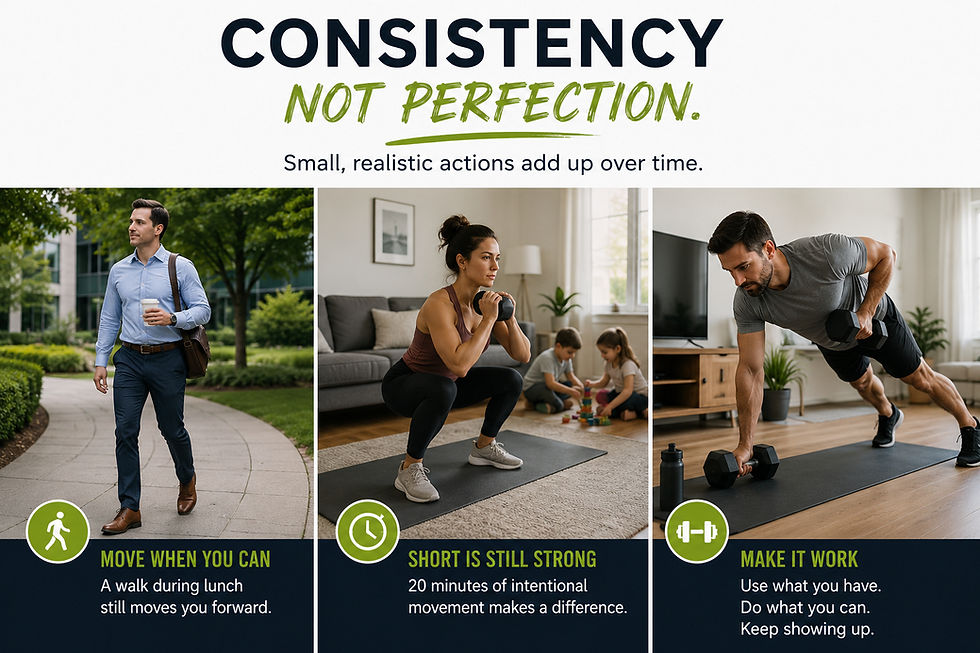
One of the biggest misconceptions about consistency is that it means never missing a workout.
In reality, consistency is much less glamorous.
It's the person who exercises three times one week and only once the next because work got busy.
It's the parent who squeezes in a twenty-minute workout between family commitments.
It's the professional who chooses to take a walk during lunch rather than doing nothing because they don't have time for a full workout.
Consistency isn't about executing a perfect plan. It's about continuing to invest in your health, even when circumstances aren't ideal.
Over time, those imperfect actions compound into meaningful results.
Fitness Should Fit Your Life
At 3 Pillars Fitness, we believe health and fitness should be simple, approachable, and sustainable.
The goal isn't to build a routine that only works when life is calm and predictable. The goal is to build habits that continue working when life becomes busy, stressful, and complicated.
Because that's the reality most adults are living.
You don't need a perfect routine.
You don't need perfect motivation.
And you certainly don't need to start over every time life gets in the way.
You simply need a plan that allows you to keep moving forward.
When fitness becomes flexible enough to fit your life, consistency becomes easier to maintain. And when consistency becomes the goal instead of perfection, lasting progress becomes much more attainable.


Comments